Weekly Wednesday Poetry for July 13, 2011
Cans like honeycomb Stacked on my desk. Is this some Caffeine addiction?
Cans like honeycomb Stacked on my desk. Is this some Caffeine addiction?
I saw the pilot movie for Max Headroom the other day. I wasn’t lucky enough to catch the pilot or the full series when it first appeared in the US in 1987. In fact, I wasn’t exposed to anything cyberpunk until 1995, when I saw The Lawnmower Man on VHS (a movie I’d like to revisit sometime). I didn’t read cyberpunk literature until late into college, when my work crew boss (and college webmaster) recommended Neuromancer by William Gibson. Afterwards, I ate up anything like Gibson’s work I could get my hands on – the rest of the Sprawl trilogy, Blade Runner, Ghost in the Shell (the manga, the movie and the TV show!), and others. But Max Headroom had to wait until just recently before I could see it.
The show follows an intrepid reporter, Edison Carter, who lives “twenty minutes into the future” in a world dominated by TV networks. After a motorcycle crash, his consciousness is copied into a powerful computer, creating the eccentric AI Max Headroom (so-named after Carter’s last thoughts before the crash). Carter recovers, and with Max he continues to investigate the gritty secrets of his media-ruled world.
Well, it’s nothing like the cyberpunk I came to love in college.
Oh coffee, keep me far from drowsiness, But stay out of my bladder’s business.
(Yeah, it’s a loose rhyme. Sue me.)
Micah in the rock. The mountain sparkles out from Underneath the moss.
(This is part 3 of an exploration of A Song of Ice and Fire by George R. R. Martin.)
Years before the events of the first book A Game of Thrones, Tywin Lannister became lord of Casterly Rock and inherited a title in shambles. His father had squandered away the family’s fast wealth, leaving them under tremendous debt. It took years for Tywin to restore the family to its prior glory, and during that time he developed a reputation as a cold-hearted, ruthless ruler. One of his “bannermen,” or lesser lords that owe allegiance to the Lannisters, was Lord Reyne of Castamere who, with Lord Tarbeck, rebelled against Tywin. Tywin defeated both, leaving nothing of either the Reynes or Tarbecks alive or standing. A bard immortalized their fall with “The Rains of Castamere,” painting Tywin Lannister in a harsh light. But Tywin took to the song, and it became his anthem for when he wanted to remind enemies and allies alike of what he is capable of.
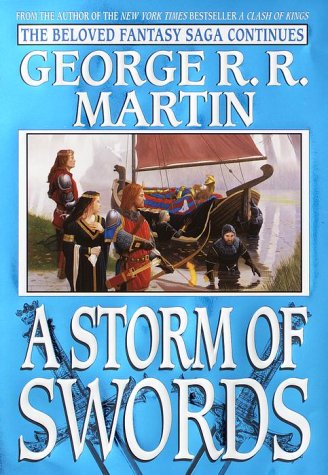
A Storm of Swords is the strongest book in the Song of Ice and Fire series. It has the most forceful (if not quite “satisfying”) conclusion, with the most significant character development. And it has a curious recurring subtext: the importance of song. People are songs; dynasties are songs; whole lands are songs.
And songs must end.
Ow ow ow ow ow Drilling out the rotted tooth. Aspirin, pretty please.

_(This is part 2 of an exploration of A Song of Ice and Fire by George R. R. Martin.)
A Clash of Kings, a story about faith, begins appropriately with a bright omen: a red comet streaking across the sky, seen by everyone in Westeros and beyond. Yet everyone reads the portent differently. The titular kings see the comet as an omen of their own victories. Peasants fear it. A widowed queen follows it across a barren desert. A Clash of Kings isn’t just about the clash of Renly Baratheon, Stannis Baratheon, Robb Stark, Joffrey Baratheon, and the rest: it’s about the clash of faiths and civilizations.
Highland mountain home, Drifting farther every day From this current life.
(This was written for a contest last October. It didn’t win – or even place – but I rather like it, and I hope you do too.)
Landbury knew if they didn’t reach harbor soon they would lose the Muenster from Mare Tranquilitatis, and it would cost him his captaincy. They had to face the celestial typhoon.
“Storm’s a Scorpio,” Hillbrand said. “She’ll sting ya, you’re not careful.”
The hills still whisper. I’ve smuggled their heart away. They miss me the most.